I’m pleased to announce that my most recent article, Absence of Anogenital Injury in the Adolescent/Adult Female Sexual Assault Patient (PDF), is now available for download from the AEquitas website. Please feel free to share!
Categories
I’m pleased to announce that my most recent article, Absence of Anogenital Injury in the Adolescent/Adult Female Sexual Assault Patient (PDF), is now available for download from the AEquitas website. Please feel free to share!
October 11th, 2012 has been designated as the 1st International Day of the Girl Child by the United Nations General Assembly. “The day was established to recognize girls’ rights and the unique challenges they face around the world.” Check out USAID’s page commemorating the day and providing links to the assorted USAID’S programs supporting the health and welfare of girls and young women around the world. This includes programs focusing on trafficking, child marriage and gender-based violence. You can also check out UN Women for articles and resources related to the day. And on Twitter: #dayofthegirl or #girlsday.
The National Child Protection Training Center is offering a webinar: The Impact of Human Trafficking on Children. The session will be held Thursday, October 18th at 2pm CST. There is a $30 registration fee, which unfortunately doesn’t provide CEs for medical folks (but does for law enforcement and attorneys, so please share).
I am in Puerto Rico, preparing for this year’s Assembly, which is one of the highlights of my year. I always look forward to this annual gathering, both because of the content of the conference and the people with whom I spend time. To the extent that I am able, I will be livetweeting the conference. I encourage others who are here to do the same. This year’s hashtag is #iafn2012. If you won’t be able to join us, I hope you’ll join along on Twitter.
(And Happy Thanksgiving to our Canadian readers!)
I had a request for literature related to TBI & domestic violence victimization, so I thought I would post the lit compilation for FHO readers. As always, let me know if you want the word doc.
Half the Sky, a documentary based on the book of the same name, was shown on PBS October 1 & 2. However, if you missed it, it’s available in its entirety thru October 10 online. I haven’t seen it yet, but I read the book after it was given to me as a wonderfully thoughtful speaker’s gift. “Half the Sky follows six celebrity activists including Diane Lane, America Ferrera, Olivia Wilde, and Gabrielle Union as they travel to nine countries and meet inspiring, courageous individuals who are confronting oppression and developing real, meaningful solutions.”
See also: http://www.halftheskymovement.org/
I think about body language a lot–particularly when I’m in court. I am always very aware of my posture and position when I am sitting listening to testimony and certainly when I am on the stand. There’s no question body language influences how people see you and assumptions that are subsequently made. But I hadn’t really considered how body language impacts our own self-concept.
OVC TTAC has a curriculum now available for supporting crime victims with disabilities. It’s a 3-day training that includes both an instructor and participant manual, PPT slides and worksheets/activities, all free of charge. Click through for a description of the course.
It’s hard to believe that in less than a week I will be heading to Puerto Rico for the 2012 IAFN Annual Scientific Assembly. I am so excited to see friends and colleagues, and this year’s sessions are going to be pretty fantastic. As always, please come find me and say hello. I will be running around like a crazy person this year, I’m sure, but I will be a lot more visible in my presidential duties, so I am looking forward to getting to meet many more of you. Of course, before we can even look to next week, let’s take a look back at what’s been going on since last we spoke:
The Colorado Coalition Against Sexual Assault is offering a webinar on October 18th from 12-1:30 MDT, Reproductive Coercion: An Introductory Train-the-Trainer Webinar. Click through for a full description of the session:
I was scanning my Facebook page and came across a blog post shared by my friends over at the OSATF on the issue of pelvic exams under anesthesia. While this practice is not legal in the state in which I reside, the fact of the matter is that most states don’t have laws on the books prohibiting the practice of allowing students to learn how to do pelvics on anesthetized women who have not specifically consented to the exam. It’s still apparently happening in enough hospitals that the October 2012 issue of the green journal addresses this in two opinion pieces.
Here’s another live event in DC that will also be webcast (although it will be an archived one, not in real time like yesterday’s post): Dr. Rebecca Campbell will be speaking on October 29th from 10-11:30 am. Her presentation will be The Neurobiology of Sexual Assault: Implications for First Responders in Law Enforcement, Prosecution and Victim Advocacy. It’s part of the National Institute of Justice’s Research for the Real World seminar series (past recordings are available here).
As part of DV Awareness Month, the US Department of Health and Human Services is hosting a panel discussion on screening and counseling for intimate partner violence in the healthcare setting. It will be held October 9th from 1-3pm ET, and will be both live (in DC) and webcast. If you’d like to participate in either medium, you can register here (registration is still required for webcast).
Although we were happily celebrating repeal in my household, plenty of other topics were front and center in the media this weekend. Much of my focus has been trained on the hashtag #SGSGlobal (the Social Good Summit going on through today); check out that and the the other items grabbing my attention since last we spoke:
A new report is out from the Bureau of Justice Statistics: Prevalence of Violent Crime Among Households with Children, 1993-2010. From the site:
The report estimates the number of children age 17 or younger living in households in which at least one household member age 12 or older experienced violent crime during a given year. As defined in NCVS, nonfatal violent victimizations include rape, sexual assault, robbery, aggravated assault, and simple assault. Estimates of the number of children are provided by age of children (ages 0 to 11 and ages 12 to 17), type of crime, and location of the crime. The report also examines households that experienced violent crime by whether children lived in the household, type of crime, and location of the crime. Data on victimized households by type, composition, and characteristic are also presented.
One year ago today Don’t Ask, Don’t Tell was repealed. For my family, that has had an enormous impact. All for the good…
October 10th is Health Cares About Domestic Violence Day, and Futures Without Violence will be hosting a webinar as part of the day’s events. School-based Health Services, Adolescent Health and Anticipatory Guidance for Domestic Violence/Sexual Assault will be held from 9-10:30 am PT. Cumbersome title aside, it should be a good session that’s very clinically focused. Unfortunately, it doesn’t appear that CE/CEUs are available.
The new issue of the New Yorker magazine has a piece by Malcolm Gladwell, In Plain View: How Child Molesters Get Away With It. It focuses on Jerry Sandusky, but of course, in the wake of this week’s emerging news about cover ups from the Boy Scouts (to name but one high profile series of offenses against kids), it’s timely for a variety of reasons.
L’shana Tovah to all my friends and colleagues celebrating the Jewish New Year (5773)! As is almost always the case on a Jewish holiday, I am hanging out with the military (this time at Maxwell AFB). I did manage to bake an apple and honey cake before leaving, my singular nod to tradition this year. As you all know, there is always work to be done, new year or not. But before I head out to teach for the day, a few things I’ve been reading since last we spoke:
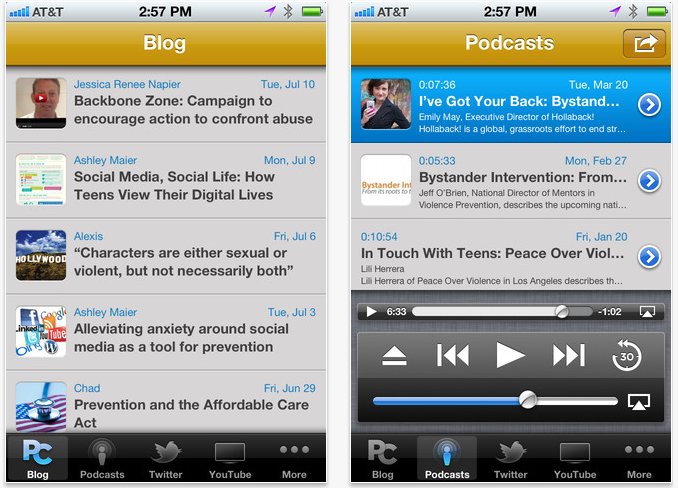
I had a chance yesterday to download and explore the new app by PreventConnect. It’s available for iPod/iPad (and soon for Android) and will allow you to access their library of podcasts as well as their blog posts (which are full of great information, like current research and emerging issues) and videos. Screenshot after the jump: