
Come back Monday to find out how you can get your own forensic-leaning temporary tattoos, see the full set (yes, there are more!), and learn how one lucky FHO reader will win the whole set for him/herself.
Have a great weekend!
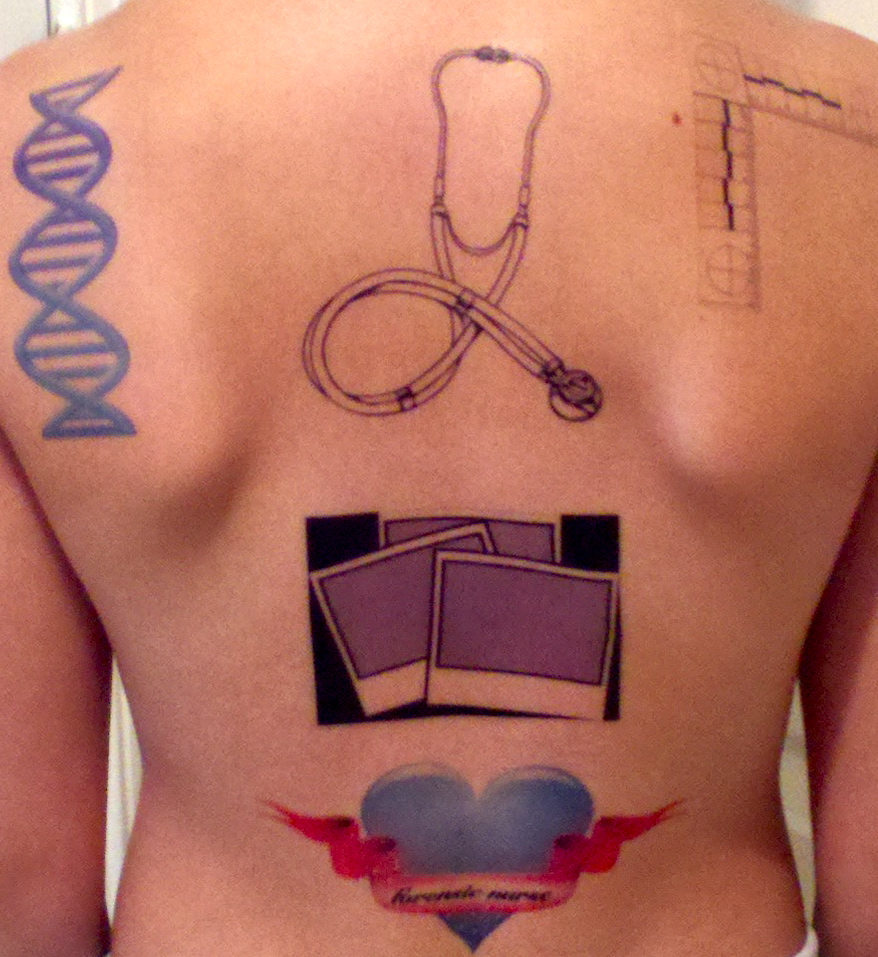
Come back Monday to find out how you can get your own forensic-leaning temporary tattoos, see the full set (yes, there are more!), and learn how one lucky FHO reader will win the whole set for him/herself.
Have a great weekend!
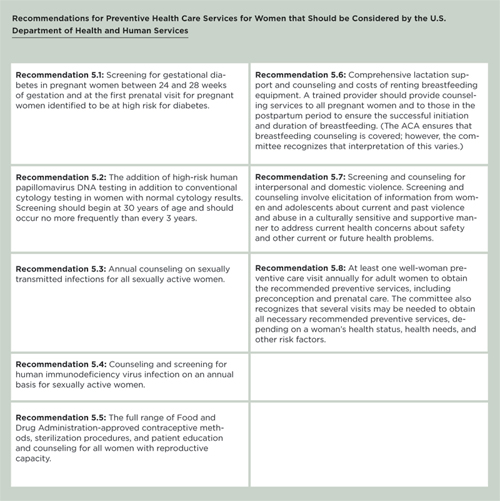
Some of you may have been following the release of the Institute of Medicine’s report on clinical preventive services for women. This is a big, big deal for a number of reasons, not the least of which is their recommendation that women have access to birth control without a co-pay. But did you know their were some violence-related issues addressed in thew new report, as well?
The other day I posted on the Newsweek article about prostitution and human trafficking, and judging by the unbelievable number of hits, FHO readers have some significant interest in the topic. So I wanted to follow up with a resource on providing healthcare for victims of trafficking.
VAWNet has just published a brand new special collection on intimate partner homicide prevention that looks fantastic. It has a lot of the resources we frequently use when teaching on the topic of assessing dangerousness, in particular, that I really appreciate. See the full table of contents (with links) after the jump.
Crazy busy here at FHO headquarters this morning (and by headquarters, I of course mean my kitchen), so I will leave you with an interesting read, especially for all of you doing anti-trafficking work. Check out Newsweek’s article, The John Next Door, about the growing demand for prostitution. Some very intriguing research featured in the piece.
(Hat tip: WCSAP)
Can we all agree on one thing? The BAC threshold of .08 is not a measure of sobriety in general terms. It is a measure of a person’s sobriety as it pertains to safely operating a motor vehicle. I would like to ask my colleagues who are turning patients away because they are blowing > .08 to please reconsider this practice. Denying patients care because their BAC is over the legal limit to operate a motor vehicle makes no sense.

I am consulting on a couple cases right now, so testimony is on my mind. Today I am going to post my Expert Witness’ Bill of Rights. By all means, please do add to this if you come up with any I have missed. Also remember, this is opinion and opinion only. Just because I think it’s true doesn’t mean you will agree, or that the attorneys you work with will care what I think (in fact I’d say it’s a solid bet that they won’t). So, with all those caveats, here are what I consider to be essential considerations for taking on the role of expert witness:
One of FHO’s readers sent me an article this morning on an appellate decision related to the use of Facebook. The decision centered around whether a student at the University of Minnesota could be disciplined because of Facebook posts created off campus and outside of academic hours. And so far, the answer continues to be yes. I post this because when I speak on the issue of defensible practice, a topic about which I am passionate, one of the key areas I touch on is the use of social media. As I’ve written previously, I am a huge fan of things like Facebook, and obviously there’s this blog, and it’s connected to my Twitter feed, so, yeah, I’m all over the interwebs.
The American Academy of Pediatrics has released a new policy statement—Protecting Children From Sexual Abuse by Health Care Providers (PDF). Medscape has an overview of the statement, with a CME activity attached (sorry, physicians only). It’s an interesting read, and one that addresses an issue I’ve not seen other organizations address (hello, AMA?).
Workplace Violence 101 is being offered by the ePanic Button. It’s a good starting place for those of you trying to engage your agencies in looking at policies related to violence in the workplace. The session will be held July 22nd from 2:30-3:30 pm ET and is free of charge.
Providing emergency contraception (EC) is a standard part of the sexual assault medical-forensic exam. However, I find that a lot of clinicians have a difficult time explaining how EC works so that patients can make a well-informed choice about whether they want it. So I was pleased to get an email yesterday announcing the availability of a new fact sheet on EC (PDF), outlining what the science tells us about mechanism of action. It should be a great resource to provide team members and our collaborating colleagues in the emergency departments who are often responsible for having similar conversations with patients.
Can I tell you how long I have been waiting to get to post this? It is with great excitement that I can announce IAFN’s free adolescent/adult web-based SAFE training and clinical workshop (clinical workshop, people! How amazing is that?). Full details after the jump.
Have you seen this site? It’s a really interesting idea from the United Nations Entity for Gender Equality and the Empowerment of Women. It’s been live for awhile now, but I have only just come across it (again, thanks Twitter). What’s fascinating about it is that it is more social media than similar sites. And it’s in French, English and Spanish.
With all the press surrounding the Dominique Strauss-Kahn case, it’s hard not to comment. But quite frankly, there’s plenty that’s already been said (and in some cases, said really well), so I’ll leave it at this: in my 16 years of taking care of sexual assault patients, I have yet to meet the victim that could withstand the kind of scrutiny that has been leveled at the victim in this case. The kind of victim who has no embarrassing, or god forbid, illegal, actions in her past (distant or otherwise); who comes forward immediately and is consistent down to the word in her repeated retellings of the events; who only associates with people of unimpeachable character; who is able to catalog everything she drinks prior to the assault, and everyone she talks to before and after; and who has never been assaulted in the past. All that makes us human makes us lousy sexual assault witnesses, each and every one of us.
Oh, I do love a good expert witness webinar. And IAFN and AALNC are offering a joint one Auguts 17th at 3pm ET, The Nurse Expert Witness: The Basics and Beyond (plus they’re offering CEUs). Registration’s not yet open for this event, but it’s worth getting on your calendar, and I will update the page when it becomes available .
I have a lot of respected friends and colleagues who care for pediatric abusive head trauma and sexual abuse patients. And I have a lot of respected friends and colleagues who prosecute these cases. So I will be interested in feedback about this particular Frontline program (it debuted last night on PBS) that looks at child fatalities and its central premise that some forensic pathologists are ill-equipped to fully explore cause of death in child cases where abuse is suspected.
I have had quite a few emails from my Photo post the other day, including several questions about how to get stronger on the foundations–simply understanding the way the camera works and how to take a basic shot. In a lovely example of the planets aligning, Lifehacker, a favorite timesuck of mine, has a new Night School post, The Basics of Photography: The Complete Guide.
In the US, the Department of Health and Human Services provides science-based healthcare objectives for the country in a document called Healthy People. Healthy People 2020 was released at the end of last year, and if you haven’t had a chance to see it (made easier by a pretty decent website), it’s worth looking at. Struggling to get your healthcare agency to continue supporting your program? Trying to explain to a judge or jury why what you do isn’t just evidence collection, but healthcare? Well, Healthy People is a good way to underscore this point–by looking at the Healthy People 2010 outcomes (like this one specific to IPV), and by pointing to what the country’s objectives are in the newest version.
At the request of several readers, I have added a 10 Things tab to the top nav where you can find all of the lists I’ve published to date. Thanks for asking!
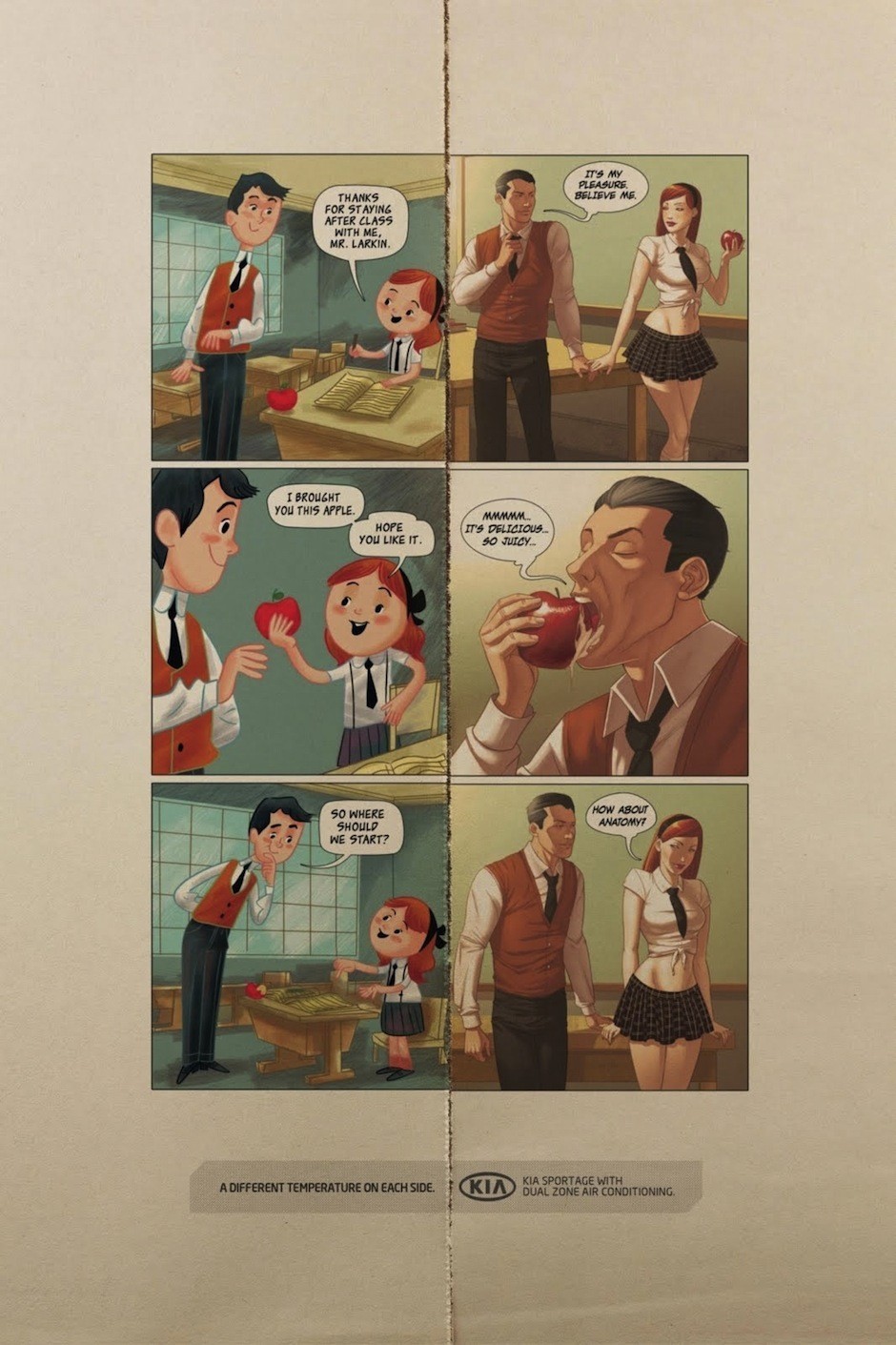
Clearly, I’m having trouble grasping just what Kia Motors thought was a great marketing nugget in this particular ad: