
I’m in Montana this week, teaching a SANE course, so you know it’s going to be a busy one. I’ll try and keep posts regular, but I’m asking for a bit of leeway on that. You just never know what your connectivity and your time looks like during one of these weeks. My hope is that among other things, you’ll see a new Articles of Note (I may be overly optimistic). In the meantime, here’s some of what I’ve been reading since last we spoke:
OJJDP has a new bulletin out: Children’s Exposure to Violence and the Intersection Between Delinquency and Victimization (PDF). This is the latest in their series on the National Survey of Children Exposed to Violence–find all of them here. And you can review the full survey results here.
Categories
Zombie Pandemic
What better day to remind folks of this hilarious CDC resource than Halloween? Don’t miss their comic book, Preparedness 101: Zombie Pandemic (PDF) and the other components of the Zombie blog to get a refresher on disaster preparedness.
Happy Halloween!
One of the conversations I had with a physician in Anaheim last week was the issue of reconciling the presence of SANE programs with the need to get EM residents trained in case they end up at a hospital without SANE programming (and most recent data from IAFN tells us that about 13% of US hospitals have SANE programs, so that chance is very good). I knew I had flagged an article on this very topic recently, and happily it’s free full-text. So here you go–a worthwhile read for sure: Sexual Assault Training in Emergency Residencies: A Survey of Program Directors (Western Journal of Emergency Medicine). And not for nothing, this study does a solid job in a very concise way of contrasting the training SANEs have versus the training most EM residents obtain in regards to caring for this patient population, so I’d encourage you to read this, even if you are in an organization without an emergency medicine residency.
{H/t to Kim Day for the stat}
Categories
Sex Crimes on Campus
I tweeted a link to this yesterday, but it bears a fuller write-up here: Al Jazeera America‘s flagship show, America Tonight is hosting a live town hall program on campus sexual violence at 9pm ET on Friday, November 1st. It looks like a fantastic opportunity for some meaningful conversation around this issue, and they are asking for people to share their own experiences via Facebook or Twitter (@AmericaTonight, #campusassault). Details after the jump:
So Anaheim was a fabulous, if somewhat manic busy week. It’s always fun to teach with my partner; it’s always fun spending time with people I talk to regularly, but rarely see; and it’s particularly fun meeting new folks (and folks I have met virtually, but never in person). Thanks to all of you who came and found me during the week–everywhere I went there were FHO readers telling me about how they use the site (love). But now it’s back to my regular world, and an unexpected week at home after a trial settled at the last minute, so let me fill you in on what I’ve been reading since last we spoke:
I’ve had a lot of questions this week about availability of testimony training for people who were unable to attend the conference, and I have been directing folks to the upcoming webinar, Courtroom Testimony in Adult/Adolescent Sexual Assault Cases. The excellent Tara Henry will be teaching it for the Tribal Forensic Healthcare project on November 19th from 3-4:30 ET and CEUs are available (CMEs have been applied for).
The National Health Collaborative on Violence and Abuse is hosting a webinar, The Impact of Family Violence on Military Families. The session will be held November 14th from 10-11:30 PT. CMEs are available for docs; sadly none available for nurses. Registration is free of charge.
Blog Talk Radio hosted a live discussion on lethality, firearms and domestic violence, which is available in an archived version. Additionally there is a Storified overview (via VAWnet) of the accompanying Twitter chat that you can also check out here. It’s a great conversation–I encourage you to check it out.
Categories
#4N6RN
Will be live tweeting (when I am able) from Anaheim. I hope to be one of many. Follow the conference at #4N6RN.
Next week is the annual IAFN conference, and it’s always one of the highlights of my year. It’s the only time I get to see so many of my people in one spot. This year will be more than hectic–I’m teaching a full day of testimony for the pre-conference (with my partner Sasha, because why wouldn’t I take professional advantage of living with a prosecutor?), plus 3 breakout sessions: one on sustainability with Jen Pierce-Weeks, one on writing and evaluating expert reports (also with Jen), and a military-specific testimony breakout (also with my partner).
A reader sent me a question asking if I had anything concise and, more importantly, free on asphyxia versus the narrower topic of strangulation. Turns out I do. Medscape published an article on this very subject: Pathology of Asphyxial Death. Even if you’re not interested in the death investigation aspect of the article, there’s still some useful information, including epidemiology and mechanisms of morbidity and mortality for clinicians of all stripes. There’s also an ancillary and adjunctive studies section at the end with links to some other fascinating topics.
I spend a lot of time nagging talking about using social media professionally. It’s a tool I truly believe is invaluable. Both small- and large-scale programs can benefit from using social media to stay connected, heighten awareness and educate colleagues and the public about relevant issues that can strengthen communities as a whole. And yet…[sigh] medical-forensic programs are not widely embracing its use, and individual clinicians still seem to be avoiding Twitter and other types of social media engagement more often than not. But a girl can push her own agenda dream.
Greetings from sunny Naples, FL, where I have been immersed in family for the weekend. A couple pieces of business for this Monday. First, congratulations to Deb O’Hay who is the winner of our latest giveaway! Deb, please contact me with your address so we can get your book to you. Second, although I have been surrounded by continuous family all weekend, I have managed to bookmark a few things for my flight home today. So here’s what I am (planning on) reading since last we spoke:
I’ve had a pretty terrific week in Colorado, but it’s been an exhausting one. Made all the better by virtue of the fact that I am waiting to board my 1am flight back east for a family celebration at my in-laws’ tomorrow. So forgive me for sinking pretty low on this one, but when you’re bleary eyed and jello-brained, there’s nothing like a good slide show on foreign bodies to somewhat mindlessly pass the time. {Val P, take note of slide 6, with one of your very favorite misspellings…}
Happy weekend, all.
{Don’t forget to enter our current book giveaway!}
The American Academy of Pediatrics’ Medical Home for Children and Adolescents Exposed to Violence is hosting a webinar, Practical Approaches with Patients Exposed to Multiple Types of Violence. The session will be held November 5th from 11am-12pm CT. You can see the details after the jump. If this one isn’t relevant to your practice they also have multiple archived webinars on their site, including this one: Beyond the First Exposure: The Physical, Mental, and Emotional Toll of Violence. Good stuff.
THIS GIVEAWAY IS NOW OVER. THANKS TO EVERYONE WHO ENTERED.
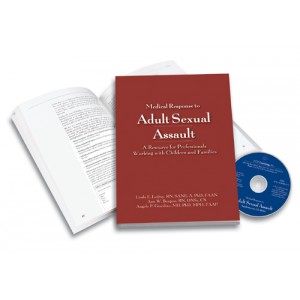
 STM Learning has a copy of their clinical text, Medical Response to Adult Sexual Assault, to give away to one FHO reader. All you have to do to be eligible to win is let us know in the Comments section of this post what other topics and/or materials you would like to see published that would assist you in your professional capacity. I will choose one winner at random from the responses at noon ET on Monday, October 14th, so be sure to get your answer in before then.
About the book:
Sexual assault remains one of the most problematic and controversial issues in law, medicine, and in society at large. Following the outcry against recent scandals, it has become even more important that medical, law enforcement, legal, social service, and other professionals possess comprehensive knowledge on all issues pertaining to rape, assault, sexual exploitation, and the exam findings of each.
Table of Contents:
1. History and Overview
2. Basic Anogenital Anatomy and Human Sexual Response
3. Body Injury and Dynamics of Sexual Assault
4. The Sexual Assault Exam: Components and Documentation
5. Biological Evidence: Collection and Use in Courtroom Testimony
6. Complications of Sexual Assault: STI and Pregnancy
7. Male Victims
8. Suspect Exams
9. Victim Impact and Recovery
10. Psychobiology of Trauma: Impact on Memory and Response
11. Education and Qualifications of the Sexual Assault Examiner
12. SART Operation
13. SART in the Military
14. Rape on Campus
15. Drug Facilitated Sexual Assault
16. Intimate Partner Violence
17. Human Trafficking
18. Elder Sexual Assault
19. Sexual Homicide
20. SANE-SART Evalutation
{Don’t forget to enter our current book giveaway!}
The Journal of Adolescent Health has a special issue out: Examining the Role of Safe, Stable, and Nurturing Relationships in the Intergenerational Continuity of Child Maltreatment. The entire issues appears to be available online free full-text so there’s no reason not to check it out. It’s a really interesting topic for a special issue, and one that we don’t see receive much air play, so I’m pretty excited about this.
Open access scientific journals have been a boon for many of us– when you have no regular access to a medical library, getting articles for free is particularly lovely. However, Science magazine just published a new article, Who’s Afraid of Peer Review?, that calls into question the peer review process in open access journals. It’s a fascinating and worthwhile read–and something to consider when we’re talking about evaluating the quality of a research study (and so I have added this one to the clinical guide). Download the full-text here (PDF).
Let me just preface this by saying that my beloved PubMed has essentially been furloughed with this shutdown, so it has a sad little message when you visit it right now–“PubMed is open, however it is being maintained with minimal staffing due to the lapse in government funding. Information will be updated to the extent possible, and the agency will attempt to respond to urgent operational inquiries. For updates regarding government operating status see USA.gov.” [insert nerd frownie face here] But we can’t stop with the Articles of Note just because the US has a spectacularly dysfunctional congress, so banish that thought.